In the first of what will likely be many similar announcements from the company, Meta has today announced that it’s expanding its reliance on artificial intelligence tools for content moderation, and reducing its use of human moderators, as it looks to put its money where its mouth is with its advancing AI technology.
Meta CEO Mark Zuckerberg has noted in several interviews that AI tools will soon be able to replace many roles, beginning with mid-level engineer type functions. And with Meta investing hundreds of billions into its AI projects, in some ways, it needs to back those claims up within its own organization to underline the value of its investment.
As explained by Meta: “Over the next few years, we’ll be deploying these more advanced AI systems across our apps once we’ve seen them consistently perform better than our current methods of content enforcement, transforming our approach. As we do this, we’ll reduce our reliance on third-party vendors for content enforcement and focus on strengthening our internal systems and workforce.”
Meta said that it will still rely on human guidance to power its moderation process. But over time, its AI tools will be able to take on work that’s better-suited to technology, “like repetitive reviews of graphic content or areas where adversarial actors are constantly changing their tactics, such as with illicit drugs sales or scams.”
The announcement comes just days after reports emerged that Meta is planning to cut up to 20% of its staff in order to increase operational efficiency. At least some of those roles will presumably be going to AI tools instead, and it’ll be interesting to see just how much Meta is willing to use its own organization as a guinea pig for its advancing AI models.
Because testing as yet unproven AI models does pose a significant risk. Earlier in the week, The Information reported that a rogue AI agent caused a security incident within Meta by exposing sensitive data about employees without authorization. These types of vulnerabilities will continue to raise alarm bells, as companies work to integrate AI systems, and give these tools more access to their data, and eliminating them will be a case-by-case proposition as engineers and designers learn about these potential flaws.
At Meta’s scale, that could be a major concern, but again, with the company sinking so much into the AI future, it has to show others the value of these systems, and why that investment makes sense.
On a related front, Meta also announced an expanded rollout of its Meta AI support assistant, which will be able to provide automated advice on common account issues.
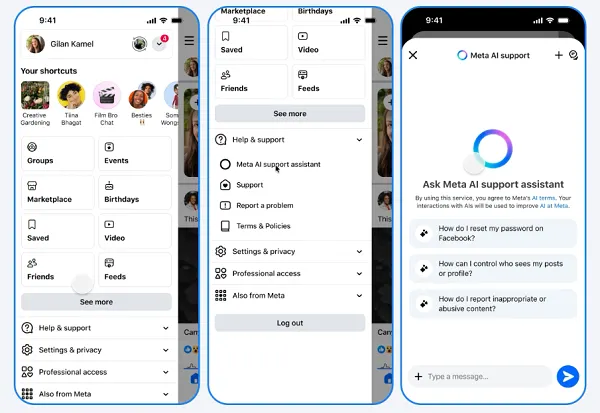
The bot is designed to provide guidance on some of the most common account concerns, and reduce queries submitted to Meta’s human team.
Meta initially previewed the tool back in December, and now, all users on Facebook and Instagram will be able to access the AI chatbot within their Facebook and Instagram options.
As per Meta: “When you have an account issue, you need a solution — not just a suggestion. The new Meta AI support assistant is designed to help resolve account problems for you from start to finish. It offers answers for any question — like about notification settings or new features — and if you’d like, it can also take action for you on a growing set of requests directly within Facebook and in the future, on Instagram.”
So, again, more AI, with Meta’s own tools becoming a showcase for its AI systems, and how they can replace human teams in certain contexts.
It’ll be interesting to see how these options reduce the demand on Meta’s resources, and how that relates to Meta’s broader push on its AI chatbots as a solution for other businesses.